
ZATCA E-Invoicing Wave 25: Who's Included and When to Integrate
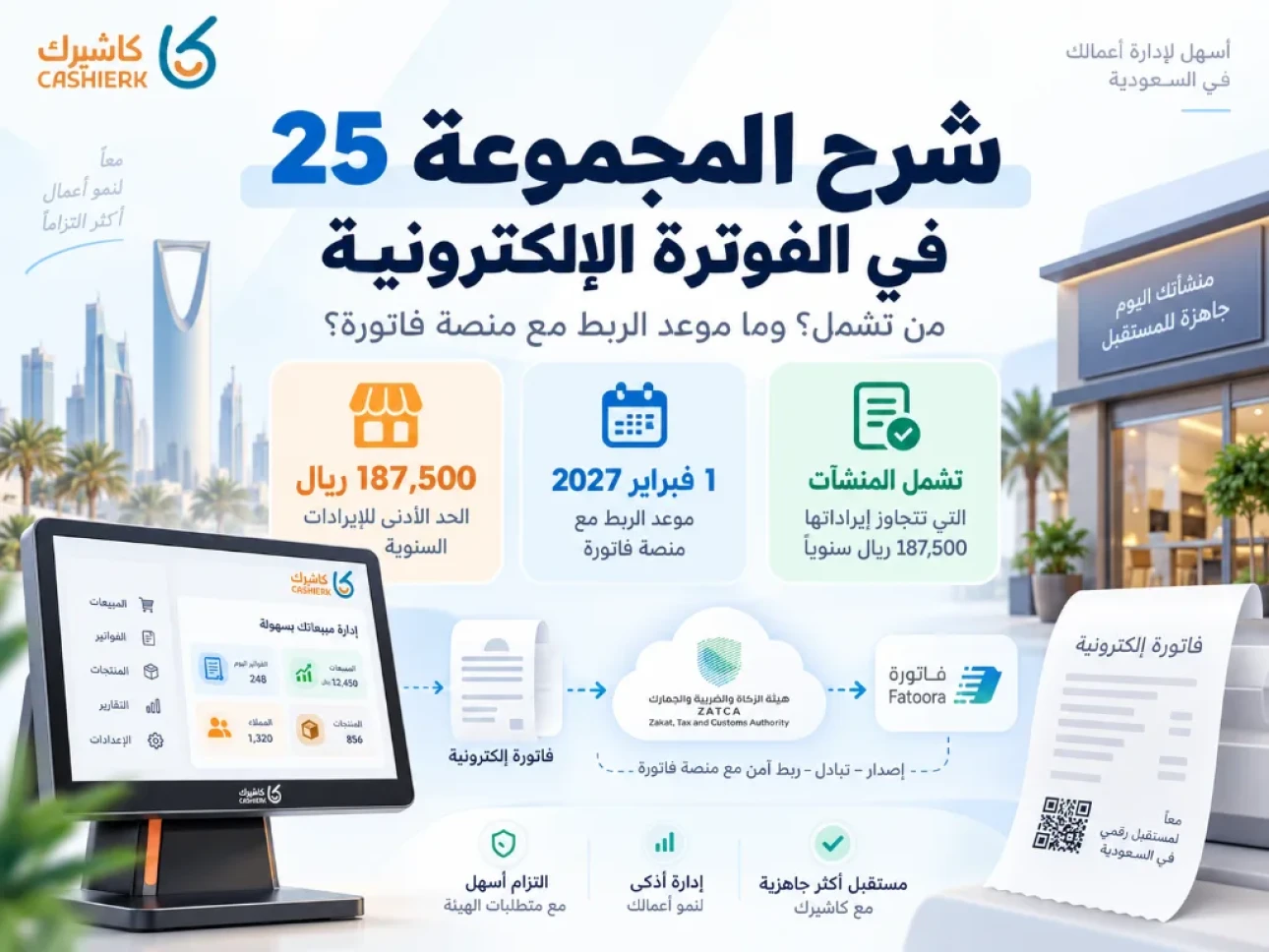
The Zakat, Tax and Customs Authority (ZATCA) has announced the criterion for selecting the businesses targeted in e-invoicing Wave 25, one of the waves covered by the Integration Phase with the Fatoora platform. According to ZATCA's announcement, Wave 25 covers businesses whose revenues subject to VAT exceeded SAR 187,500 in 2022, 2023, 2024 or 2025, and their e-invoicing systems are to be integrated with the Fatoora platform starting February 1, 2027.
This announcement matters a great deal to owners of restaurants, cafés, stores, distribution companies and small and medium-sized enterprises (SMEs), because e-invoicing is no longer just about issuing an invoice from a system. It now depends on whether your invoicing, cashier or POS system is ready to integrate with the Fatoora platform according to ZATCA's requirements.
In this guide from Kashierapp, we explain what Wave 25 means, who it covers, how to tell whether your business is included, the difference between Phase 1 and Phase 2, and what you need to prepare before the integration date.
Contents
- What is e-invoicing Wave 25?
- Who does Wave 25 cover?
- What does the SAR 187,500 threshold mean?
- Are revenues calculated before or after VAT?
- When does Wave 25 integrate with the Fatoora platform?
- Is February 1, 2027 a deadline or a start date?
- What is the difference between Phase 1 and Phase 2?
- What is required of businesses in Wave 25?
- How do you know whether your business is in Wave 25?
- How are cashier and POS software related to ZATCA integration?
- What should you prepare before integrating with the Fatoora platform?
- Common mistakes that can delay integration with the Fatoora platform
- Do you need ZATCA-compliant cashier software?
- How does Kashierapp help your business prepare for Wave 25?
- Frequently asked questions about e-invoicing Wave 25
What is e-invoicing Wave 25?
E-invoicing Wave 25 is one of the waves defined by the Zakat, Tax and Customs Authority as part of the rollout of Phase 2 of e-invoicing, known as the Integration Phase.
Wave 25 doesn't mark the start of e-invoicing in general, since Phase 1 began earlier. Rather, it means a new segment of businesses is entering the phase of integrating their e-invoicing systems with ZATCA's “Fatoora” platform.
Put simply, if your business issues invoices from cashier software, a POS system, invoicing software or an ERP system, the Integration Phase requires that system to be able to handle ZATCA's technical and regulatory requirements according to the wave your business falls into.
That's why understanding ZATCA Wave 25 is important for any business that sells products or services in Saudi Arabia and is subject to VAT.
Who does e-invoicing Wave 25 cover?
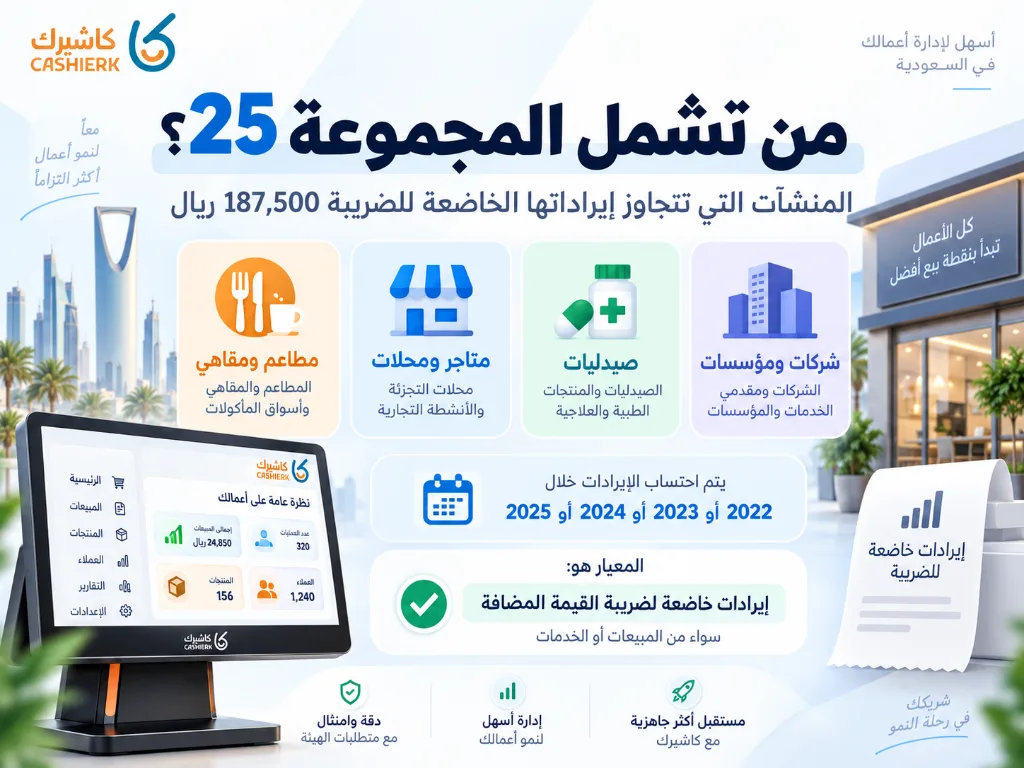
E-invoicing Wave 25 covers all businesses whose revenues subject to VAT exceeded SAR 187,500 in any of the following years: 2022, 2023, 2024 or 2025. ZATCA has also stated that it will notify all targeted businesses in preparation for integrating their e-invoicing systems with the Fatoora platform.
| Item | Details |
|---|---|
| Wave | Wave 25 / Group 25 |
| Regulator | Zakat, Tax and Customs Authority (ZATCA) |
| Phase | Integration Phase |
| Selection criterion | Revenues subject to VAT exceeding SAR 187,500 |
| Measurement years | 2022, 2023, 2024 or 2025 |
| Integration date | Starting February 1, 2027 |
| Platform | The Fatoora platform |
If your business exceeded this threshold in just one of the specified years, it may fall within the scope of Wave 25. So review your revenue data and tax returns rather than relying on a rough estimate.
What does the SAR 187,500 threshold in Wave 25 mean?
The SAR 187,500 threshold doesn't refer to net profit, your bank balance or the VAT amount alone. According to ZATCA's announcement, it refers to revenues subject to VAT.
This means business owners need to review their taxable business revenues for the years ZATCA announced: 2022, 2023, 2024 and 2025.
An illustrative example:
| Year | Revenues subject to VAT | Does it meet the Wave 25 criterion? |
|---|---|---|
| 2022 | SAR 160,000 | No, based on this year |
| 2023 | SAR 195,000 | Yes |
| 2024 | SAR 170,000 | No, based on this year |
| 2025 | SAR 180,000 | No, based on this year |
In this example, the business may be included in Wave 25 because its revenues in 2023 exceeded SAR 187,500, even though it didn't exceed the threshold in the other years.
So it's best to review your figures with your company accountant, through your tax account, or using the financial reports and invoices issued by your current system.
Are revenues calculated before or after VAT?
The official wording in ZATCA's announcement is revenues subject to VAT. So don't confuse this with total sales, net profit or the VAT collected from customers.
In practice, it's best to review:
- Your VAT returns.
- Your annual sales reports.
- The tax invoices you've issued.
- Figures from your accountant or finance manager.
- Reports from your cashier or POS system.
- Branch data, if you have more than one branch.
If your figures are close to the SAR 187,500 threshold, don't wait until the last minute. Start reviewing your invoicing, cashier and POS systems to make sure you're ready.
When does Wave 25 integrate with the Fatoora platform?
Wave 25 integration with the Fatoora platform begins on February 1, 2027, according to the Zakat, Tax and Customs Authority's announcement. This means businesses in this wave must be ready to integrate their e-invoicing systems with the Fatoora platform in line with Phase 2 requirements.
It's not advisable to wait until the date approaches, because getting your business ready for integration may involve reviewing several elements, such as:
- Business details.
- VAT registration number.
- Branch details.
- User permissions.
- Cashier system.
- Invoicing software.
- Invoice issuing points.
- How invoices are stored.
- System readiness for Phase 2.
- Testing the integration before going live.
The earlier you start, the less likely you are to run into errors at integration time.
Is February 1, 2027 a deadline or a start date?
It's more accurate to say that February 1, 2027 is the start date of integration for Wave 25 according to ZATCA's announcement, not just a general e-invoicing date. ZATCA stated that the e-invoicing systems of businesses targeted in Wave 25 will be integrated with the Fatoora platform starting from this date.
So when writing or reading any content on this topic, pay attention to the difference between:
-
The date the wave was announced.
- The date businesses are notified.
- The integration start date.
- System readiness before that date.
- Actual compliance according to the notice your business receives.
Most importantly, rely on the official notice your business receives from ZATCA, and prepare your system early so this doesn't turn into last-minute technical and administrative pressure.
What is the difference between Phase 1 and Phase 2 of e-invoicing?
E-invoicing in Saudi Arabia is being implemented in two main phases: the Generation Phase (issuing and storing invoices), followed by the Integration Phase.
Phase 1: Generation (issuing and storing)
Phase 1 of e-invoicing began on December 4, 2021. It focuses on issuing and storing invoices electronically instead of handwritten invoices or invoices created in word processors or spreadsheets.
In this phase, taxpayers are required to use an electronic system that complies with e-invoicing requirements to issue and store e-invoices and electronic notes.
Phase 2: Integration
Phase 2 began on January 1, 2023 and is being rolled out gradually in waves; it is known as the Integration Phase. It includes additional requirements, most notably integrating taxpayers' e-invoicing systems with ZATCA's system, issuing invoices in a specific format and including additional elements in the invoice.
Wave 25 is therefore part of this gradual Phase 2 rollout, not just the Generation Phase.
For more details on this topic, see Kashierapp's e-invoicing page.
What is required of businesses in Wave 25?
If your business is included in e-invoicing Wave 25, it's not enough to know the date; you need to prepare your entire working environment before integration.
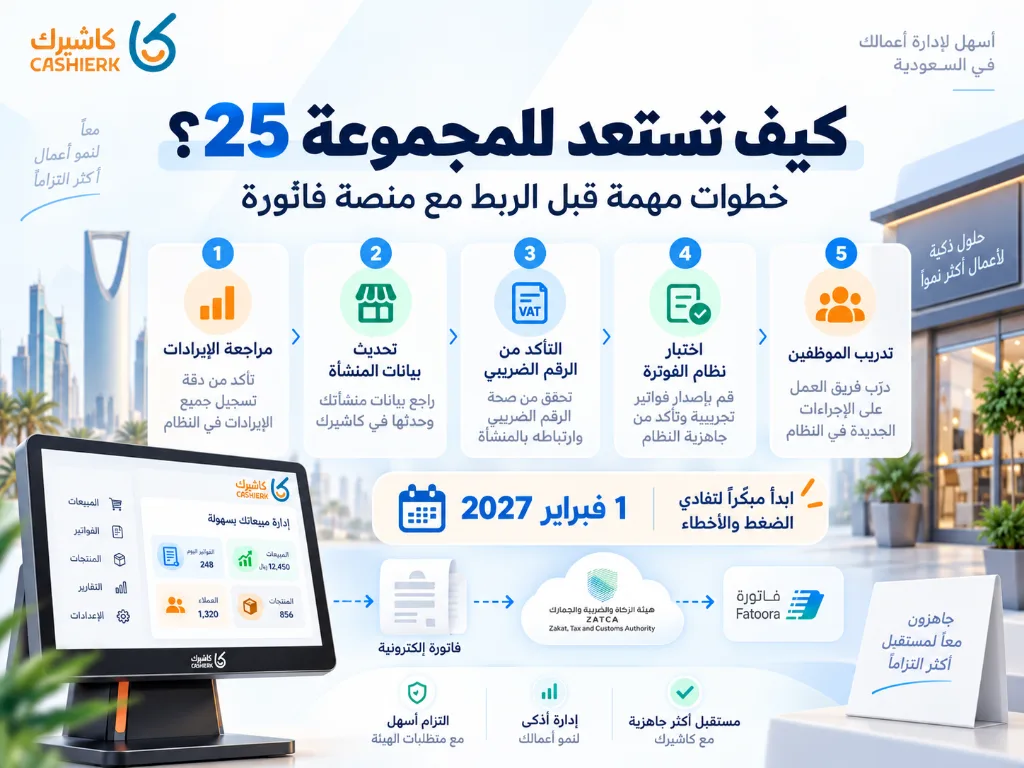
The most important things to review:
- Review your revenues subject to VAT for 2022, 2023, 2024 and 2025.
- Make sure your business details are correct and up to date.
- Review your VAT registration number and branch details.
- Make sure your invoicing or cashier system supports Phase 2 requirements.
- Review how you issue tax invoices and simplified tax invoices.
- Check user permissions within the system.
- Assign someone to be responsible for integration and follow-up.
- Contact your system provider to confirm readiness.
- Test the system before the integration date.
- Train the staff responsible for issuing invoices.
This is where an integrated system such as Kashierapp's e-invoicing software proves its value, because it helps organize invoices and link them to the daily sales operations of your business.
How do you know whether your business is in Wave 25?
To find out whether your business is in Wave 25, follow these steps:
1. Review your 2022 revenues
Start by reviewing your revenues subject to VAT in 2022, not just your gross profit or net income.
2. Review your 2023 revenues
If your taxable revenues in 2023 exceeded the SAR 187,500 threshold, your business may fall within the scope of Wave 25.
3. Review your 2024 revenues
Even if you didn't exceed the threshold in previous years, review 2024, because it's one of the announced measurement years.
4. Review your 2025 revenues
ZATCA included 2025 among the measurement years for Wave 25, so review it as well.
5. Compare each year with the SAR 187,500 threshold
Don't lump the years together arbitrarily. Review each year separately, and if your taxable revenues exceeded the threshold in any of the specified years, start preparing your system.
6. Watch for ZATCA's official notice
ZATCA has stated that it will notify all businesses targeted in Wave 25. So keep an eye on official messages and don't ignore any notice related to e-invoicing.
How are cashier and POS software related to Wave 25?
In many businesses, such as restaurants, cafés, stores, supermarkets and pharmacies, daily invoices are tied directly to the cashier software or POS system. That's why the readiness of your cashier system is a core part of your business's e-invoicing readiness.
If your current system is outdated, separate from your invoicing or doesn't provide accurate data, your business may face problems such as:
- Errors in invoice data.
- Difficulty connecting branches.
- Poor invoice tracking.
- Mismatches between sales and invoices.
- Difficulty managing permissions.
- Unclear reports.
- Having to enter data manually more than once.
With a smart POS system, on the other hand, you can link sales to invoices, reports and inventory in a more organized way, reducing the likelihood of operational errors.
If you run a restaurant or café, take a look at our restaurant cashier software.
If you run a store or retail shop, see the POS software for retail stores page.
What should you prepare before integrating with the Fatoora platform?
Before the Wave 25 integration date with the Fatoora platform, your business needs to prepare a number of key elements.
| What to prepare | Why it matters |
|---|---|
| Business details | To make sure the correct details appear on invoices |
| VAT registration number | A core element of tax invoices |
| Branch details | Important for multi-branch businesses |
| Invoicing system | Must support Phase 2 requirements |
| Cashier software | It's where invoices are issued in restaurants and stores |
| Point of sale | To keep sales and invoicing unified |
| User permissions | To define who issues invoices and who reviews them |
| Reports | To monitor invoices, sales and errors |
| Testing before going live | To reduce integration problems at rollout |
It's best to start by reviewing your current system: is it just a simple sales program, or an integrated system that manages invoices, inventory, reports and branches?
If your business relies on products and daily inventory, see the Smart Inventory Management page.
If you need to track sales and invoice performance, see the Smart Reports page.
Common mistakes that can delay integration with the Fatoora platform
1. Relying on an outdated cashier system
Some older systems may be fine for issuing a simple receipt, but they don't help businesses manage modern e-invoicing requirements or integration.
2. Not reviewing your business details
An error in the business name, VAT registration number, branch details or user details can cause problems during preparation or integration.
3. Confusing e-invoicing with ZATCA integration
A business may already be issuing e-invoices but still not be ready for the Phase 2 requirements for integration with the Fatoora platform.
4. Ignoring ZATCA notices
ZATCA's official notice is the main reference for knowing whether your business is in the targeted wave. Ignoring notices can lead to unexpected delays.
5. Using several separate systems
When you use one system for sales, another for invoices and external files for inventory, your data becomes scattered and the risk of errors increases.
6. Not testing the system before the date
Testing the system before the integration date helps you discover problems early, instead of having them surface when the requirements actually take effect.
Do you need ZATCA-compliant cashier software?
Yes. If your business's invoices are issued from cashier software or a POS system, you need a system that helps you issue organized e-invoices that comply with e-invoicing requirements in Saudi Arabia.
But one subtle point needs clarifying: ZATCA states that its list of e-invoicing solution providers is for guidance only and is not binding, and it does not constitute ZATCA approval of the technical solutions listed. ZATCA also clarifies that taxpayers may use any electronic system, provided it complies with e-invoicing requirements.
So instead of relying only on a phrase like approved restaurant cashier software, it's better to ask:
- Does the system comply with e-invoicing requirements?
- Does it support Phase 2 requirements?
- Does it help organize invoices?
- Does it link invoices to sales?
- Does it support business and tax details?
- Does it provide clear reports?
- Does it suit the nature of your business?
This is especially important for businesses with daily sales activity, such as restaurants, stores and multi-branch operations.
How does Kashierapp help your business prepare for Wave 25?
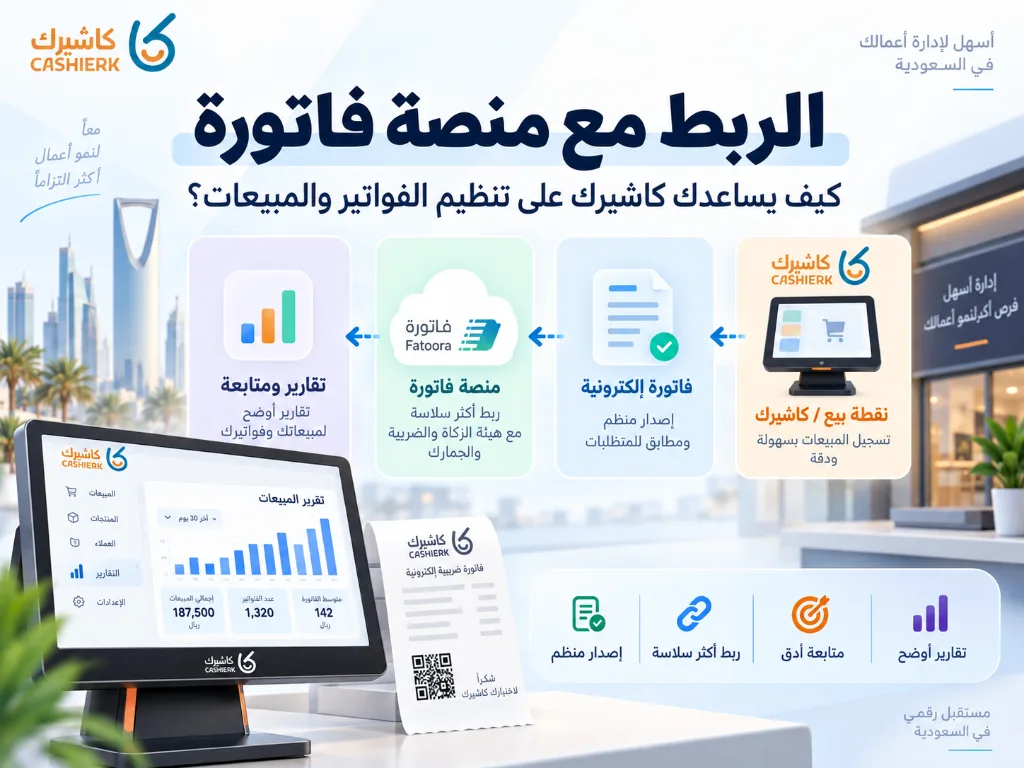
Kashierapp helps you organize sales, invoices, inventory and reports on a single platform, making your business data clearer and easier to review before you take on the integration requirements.
With Kashierapp, you can benefit from:
- E-invoicing software that helps organize how invoices are issued.
- A smart POS system that links sales to invoices.
- Restaurant cashier software suited to restaurants and cafés.
- POS software for retail stores suited to shops and retail.
- Smart Inventory Management to track products and quantities.
- Smart Reports to understand sales and branch performance.
- Advanced Branch Management for multi-branch businesses.
The idea is that preparing for e-invoicing doesn't start at the final integration step; it starts with organizing the sales and invoicing cycle within your business from the ground up.
Does Wave 25 mean all small businesses are now required to comply?
You can't say that every small business is now in Wave 25 simply because it is small or new. The Wave 25 criterion announced by ZATCA applies to businesses whose revenues subject to VAT exceeded SAR 187,500 in any of the years 2022, 2023, 2024 or 2025, and ZATCA will notify the targeted businesses.
However, because the announced threshold is lower than in previous waves, this wave may reach a larger number of SMEs, especially businesses with steady daily sales such as:
- Restaurants.
- Cafés.
- Stores.
- Retail shops.
- Supermarkets.
- Pharmacies.
- Distribution companies.
- Multi-branch businesses.
So even if you haven't received a notice yet, it's best to review your figures and prepare your system early.
A quick checklist before February 1, 2027
Use this checklist to review your business's readiness before the integration date:
- Have you reviewed your 2022 revenues?
- Have you reviewed your 2023 revenues?
- Have you reviewed your 2024 revenues?
- Have you reviewed your 2025 revenues?
- Did your revenues subject to VAT exceed SAR 187,500 in any year?
- Have you followed ZATCA's notices?
- Are your business details correct?
- Is your VAT registration number correct?
- Are your branch details up to date?
- Does your cashier system support e-invoices?
- Is your invoicing software suitable for Phase 2 requirements?
- Are your users and permissions organized?
- Has the system been tested before the integration date?
- Have you contacted your system provider to confirm readiness?
If you answered “no” to more than one item, it's best to start reviewing now rather than waiting until the date approaches.
What is the difference between invoicing-only software and an integrated cashier system?
Some businesses look for software just to issue invoices, and that may be enough in some simple cases. But in restaurants, stores and multi-branch businesses, invoicing isn't separate from operations; it's tied to sales, inventory, staff, branches and reports.
| Criterion | Invoicing-only software | Integrated cashier and POS system |
|---|---|---|
| Issuing invoices | Yes | Yes |
| Sales management | Limited | Advanced |
| Inventory management | Usually limited or separate | Linked to sales activity |
| Branch management | May need additional tools | From a single dashboard |
| Reports | Basic financial reports | Sales, operations and branch reports |
| Restaurants and stores | May not cover operational details | Designed for the daily sales cycle |
| Scalability | Limited, depending on the system | Better for growing businesses |
So if your business depends on daily sales, it's best to consider a system that links invoicing to the sale itself, rather than one that simply issues an invoice after the sale.
Why shouldn't you wait until the integration date approaches?
Waiting until the integration date is near can put pressure on your business, especially if you discover late that your current system doesn't cover the requirements or that your branch and user data is disorganized.
Starting early helps you:
- Review your data without rushing.
- Choose a system that suits the nature of your business.
- Train your staff.
- Test invoice issuing.
- Organize your inventory and sales.
- Reduce operational errors.
- Prepare for any updates or additional requirements.
The more organized your sales and invoice data, the easier it is to handle e-invoicing requirements.
Frequently asked questions about e-invoicing Wave 25
What is e-invoicing Wave 25?
Wave 25 is one of the waves of the e-invoicing Integration Phase. It covers businesses that ZATCA has identified based on a criterion of revenues subject to VAT.
Who does Wave 25 cover?
According to ZATCA's announcement, Wave 25 covers businesses whose revenues subject to VAT exceeded SAR 187,500 in 2022, 2023, 2024 or 2025.
What is the revenue threshold for Wave 25?
The announced revenue threshold for Wave 25 is more than SAR 187,500 in revenues subject to VAT in any of the specified years.
Does SAR 187,500 mean net profit?
No. It refers to revenues subject to VAT, not net profit or the VAT amount alone.
When does Wave 25 integrate with the Fatoora platform?
Integration of Wave 25 with the Fatoora platform begins on February 1, 2027, according to the Zakat, Tax and Customs Authority's announcement.
Is February 1, 2027 a deadline?
It's more accurate to call it the start date of integration for Wave 25 according to ZATCA's announcement. Every business should follow its official notice and prepare its system before this date.
How do I know whether my business is included in Wave 25?
Review your revenues subject to VAT for 2022, 2023, 2024 and 2025, compare each year with the SAR 187,500 threshold, and watch for ZATCA's official notice.
What is the difference between Phase 1 and Phase 2 of e-invoicing?
Phase 1 is the Generation Phase (issuing and storing invoices), which began on December 4, 2021. Phase 2 is the Integration Phase, which has been rolled out gradually since January 1, 2023 and includes integrating e-invoicing systems with ZATCA's system and issuing invoices in a specific format.
Do I need ZATCA-compliant cashier software?
If your business's invoices are issued from a cashier or POS system, you need a system that helps you issue organized e-invoices that comply with e-invoicing requirements.
Does ZATCA's solution provider directory mean the software is approved?
No. ZATCA states that its list of solution providers is for guidance only and is not binding, and it is not an approval of the technical solutions listed. Taxpayers may use any electronic system as long as it complies with e-invoicing requirements.
What should I do if my current cashier system doesn't support integration?
Start by checking with your current system provider and confirm it can support Phase 2 requirements. If the system is limited or doesn't suit the nature of your business, consider switching to a more integrated system for managing invoices, sales and points of sale.
How does Kashierapp help prepare my business for e-invoicing?
Kashierapp helps you organize invoices, sales, points of sale, inventory, reports and branches on a single platform, making it easier to review your business data and strengthening your operational readiness for e-invoicing requirements.
Get your business ready for Wave 25 with Kashierapp
If your business is in e-invoicing Wave 25 or expects to fall within the scope of integration with the Fatoora platform, start reviewing your cashier, invoicing and POS systems now.
Kashierapp helps you manage sales, invoices, inventory, reports and branches on a single platform, supporting your business's operational readiness for e-invoicing requirements in Saudi Arabia.
Get started now by contacting the Kashierapp team to choose the solution that best fits your business.
Best Cashier Software in Saudi Arabia for Restaurants and Stores
Choosing the best cashier software in Saudi Arabia is no longer just about selling quickly; it has become a core...
Read the article
Best Cashier Software in Saudi Arabia: Sales, Stock, E-Invoices
Choosing the best cashier software in Saudi Arabia is no longer a simple decision about how fast you can issue...
Read the article
Financial Accounting: A Complete Guide for Your Business
What is financial accounting?Financial accounting is the process of recording, classifying and summarizing a company's financial transactions (see also: Simplified...
Read the article
What Is Kashierapp? Cloud Cashier Software and Its Key Features
Kashierapp cashier softwareCashier software (a point of sale (POS) system ) is one of the essential tools for managing sales...
Read the article
What Is Kashierapp? A Guide to POS and Cloud Point of Sale
A cashier system is no longer just a device for taking payments or printing receipts in a shop. Today, the...
Read the article
Saudi VAT Number 2026: Registration, Verification and VAT vs TIN
As tax legislation in Saudi Arabia keeps evolving, and as e-invoicing and the Integration phase with the Zakat, Tax and...
Read the article Riyadh - King Fahd Road - Al Yamamah Tower, 1st Floor - Office 102

